Hurricane Season and Assisted Living in Naples: Questions Families Should Ask
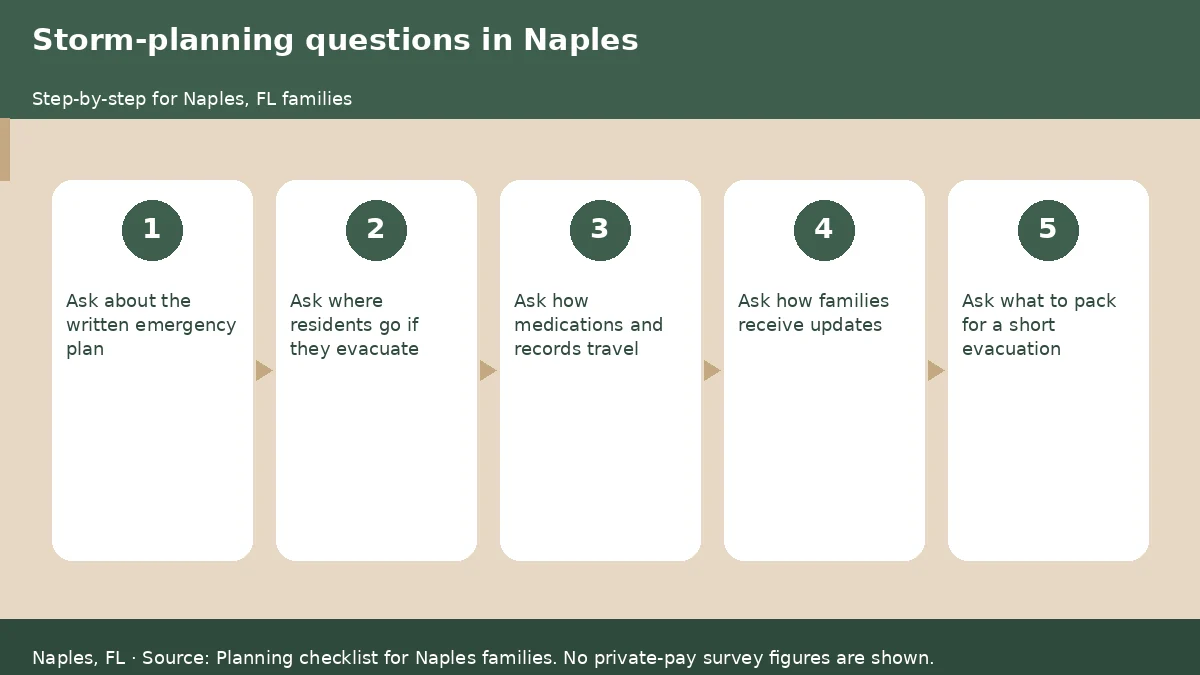
For families in Naples, choosing assisted living involves a question that families in many other places never have to ask: what happens when a hurricane comes? Collier County has seen powerful storms, long power outages, and evacuations. Older adults, especially those with health conditions or dementia, are among the most vulnerable during and after a storm. Florida has specific rules for how assisted living facilities prepare, and knowing them helps you ask the right questions.
Why hurricanes matter so much for older adults
Extreme heat after a power outage, interrupted medications, disrupted routines, and the stress of evacuation can all be dangerous for frail older adults. People living with dementia may become more confused or agitated when routines change. Someone who relies on oxygen or other powered medical equipment needs a reliable power plan. A facility's emergency planning is therefore part of the care it provides, not an afterthought, and it deserves as much attention on a tour as the dining room or the activity calendar.
What Florida requires: emergency power
Florida's Agency for Health Care Administration rule on emergency environmental control requires every assisted living facility to prepare a detailed plan, as a supplement to its Comprehensive Emergency Management Plan, for keeping residents safe if primary electrical power is lost (Fla. Admin. Code R. 59A-36.025). Key requirements include:
- An alternate power source, such as a generator, maintained at the facility, sufficient to keep ambient air temperatures at or below 81 degrees Fahrenheit for at least 96 hours after loss of primary power
- A cooled area large enough for residents. The required temperature must be maintained in an area of sufficient size to keep residents safe, with at least 20 net square feet per resident for planning purposes
- Procedures for monitoring residents for signs of heat-related injury
The rule recognizes that the cooled area may be part of the building rather than the whole building, provided residents can gather there when they wish and are monitored.
What Florida requires: emergency management plans
Florida assisted living facilities must maintain a Comprehensive Emergency Management Plan, which the environmental control plan supplements. Ask to see a summary of the plan, and ask how it has worked in practice during recent storms.
Questions to ask about power and cooling
- What alternate power source do you have, and what does it power?
- Which area of the home is kept cool during an outage, and how large is it?
- How much fuel do you keep on site, and how do you get more during an emergency?
- How often is the generator tested?
- How do you monitor residents for heat-related illness?
- What happens to residents who use oxygen concentrators or other powered equipment?
Questions to ask about evacuation
- Under what circumstances would you evacuate?
- Where would residents go, and how would they get there?
- Do residents go together, with familiar staff?
- How are medications, medical records, and personal items brought along?
- How and when would families be notified?
- What happened during the last evacuation or major storm?
If a facility decides to shelter in place, ask how it decides, and what supplies of water, food, and medications it keeps.
Questions to ask about staffing during a storm
- How do you make sure enough caregivers are present before, during, and after a storm?
- Do staff stay on site during a hurricane? How are their own families accommodated?
- Who makes decisions if the administrator cannot reach the building?
Staffing can be the hardest part of storm response, especially in a small home. A clear answer is reassuring. A vague one is a reason to keep asking, or to keep looking elsewhere.
Questions to ask about medications and supplies
- How many days of medications do you keep on hand during hurricane season?
- How do you get prescriptions refilled if pharmacies close?
- How much water and non-perishable food do you store?
- How are special diets maintained during an outage?
Questions to ask about dementia care during a storm
For residents with memory changes, a storm can be frightening and disorienting. Ask:
- How do you keep routines as normal as possible?
- How do you reassure residents who are anxious or confused?
- If you evacuate, how do you keep residents with dementia safe and supervised in an unfamiliar place?
Our article on assisted living versus memory care in Naples covers other dementia care questions.
Checking a facility's record
Florida's FloridaHealthFinder.gov website lets families look up licensed assisted living facilities, view license types and inspection reports, and compare facilities (AHCA, Assisted Living in Florida guide, PDF). Inspection reports can show whether a facility has had problems with emergency planning or other requirements, and how quickly it corrected them. Our article on Florida assisted living licensing explains how to read them.
What families can do
Even with a good facility plan, families have a role:
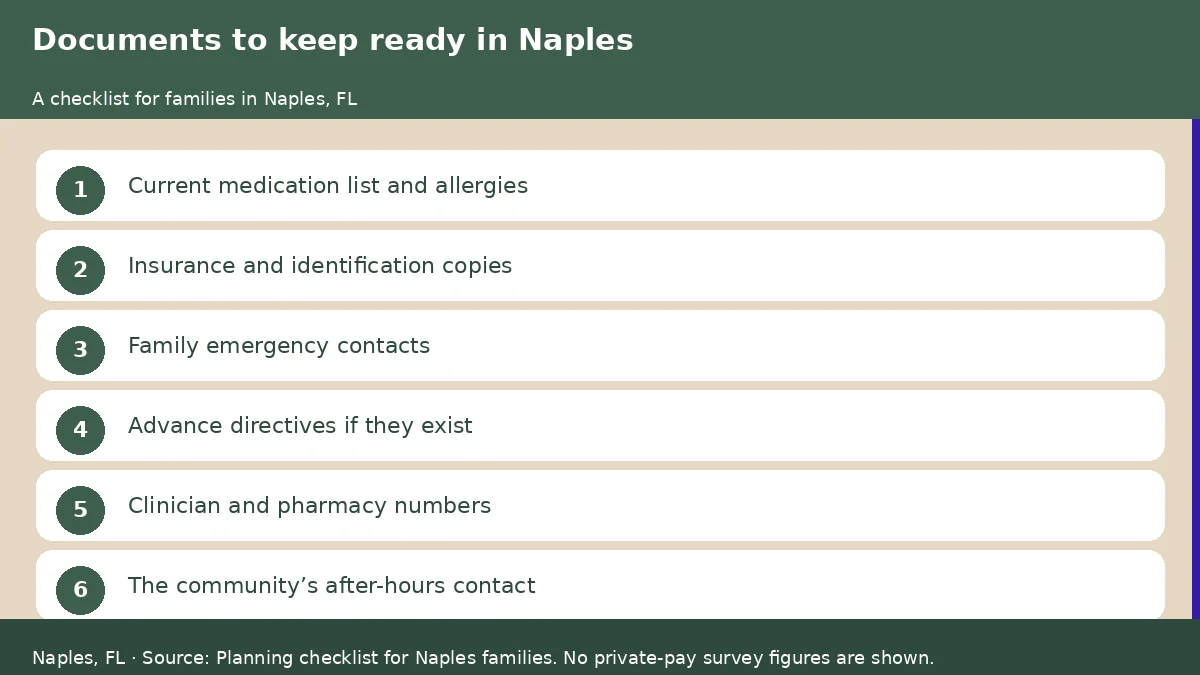
- Keep contact information current with the facility, including a backup contact outside the area.
- Know the plan. Ask the facility to tell you early in hurricane season where residents would go if they evacuated.
- Keep copies of your parent's medication list, insurance cards, and legal documents.
- Decide in advance whether you would take your parent with you if you evacuate, and tell the facility.
- Stay in touch after the storm. Phone lines may be overloaded; agree on how updates will be shared.
Getting help
The Area Agency on Aging for Southwest Florida's Elder Helpline, 866-413-5337, can connect Collier County families with local services (Area Agency on Aging for SWFL, Elder Helpline). The Florida Long-Term Care Ombudsman Program advocates for residents of assisted living facilities and can be reached at (888) 831-0404 (Florida Long-Term Care Ombudsman Program).
Talk with Bear Country Living
Bear Country Living is a residential home at 360 37th Avenue NE in Naples. We welcome questions about emergency planning along with everything else. Call (239) 467-6054 to confirm current availability and ask how we prepare for storm season, or plan a visit.
Frequently asked questions
Do Florida assisted living facilities have to have generators?
Florida rule 59A-36.025 requires each assisted living facility to have a sufficient alternate power source, such as a generator, to keep temperatures at or below 81 degrees Fahrenheit for at least 96 hours after a power loss.
Does the whole building have to be cooled?
Not necessarily. The rule allows a designated area of sufficient size, with at least 20 net square feet per resident for planning purposes, as long as residents can gather there and are monitored.
What should I ask an assisted living facility about hurricanes?
Ask about backup power and cooling, fuel supply, evacuation plans, staffing during storms, medication supplies, and how families are kept informed.
Who can help if I have concerns about a facility's emergency planning?
You can contact the Florida Long-Term Care Ombudsman Program at (888) 831-0404 or file a complaint with AHCA at (888) 419-3456.