Memory Care Costs in Naples: What Collier County Families Should Know
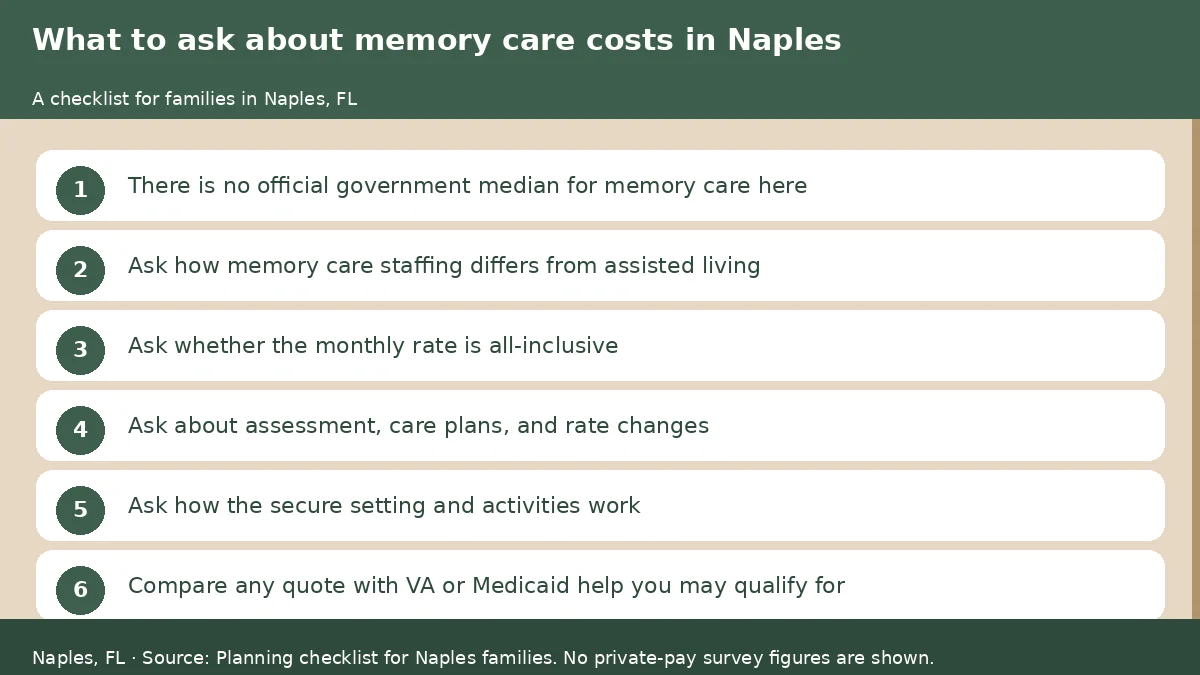
There is no official federal or Florida survey that publishes a private-pay median for memory care in Naples. Memory care is usually priced higher than standard assisted living because of staffing, training, and a more structured setting, but the only reliable figure is a written quote.
Medicare does not pay for room, board, or ongoing custodial care in assisted living if that is the only care someone needs (Medicare.gov: long-term care coverage).
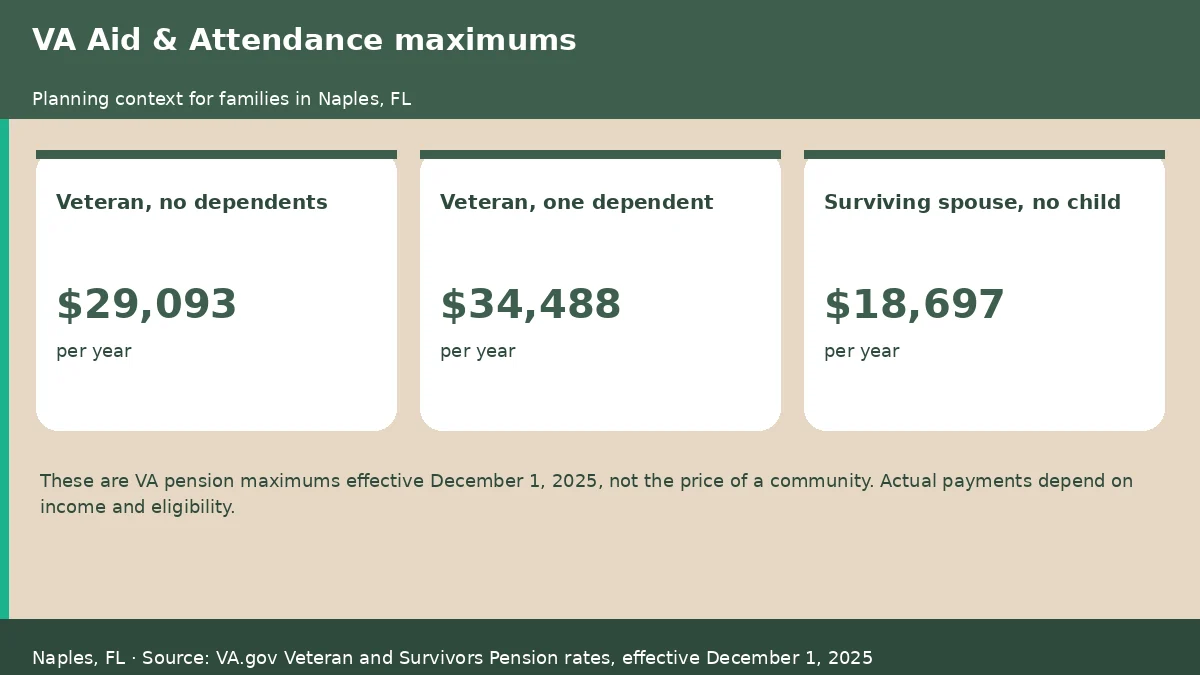
Eligible wartime Veterans and surviving spouses can review VA pension with Aid and Attendance. As of December 1, 2025, the maximum annual pension rate with Aid and Attendance is $29,093 for a Veteran with no dependents and $34,488 for a Veteran with one dependent (current VA pension rates). A surviving spouse’s Aid and Attendance maximum is $18,697 a year with no dependent children (VA Survivors Pension rates). These are benefit limits, not the price of a Naples community. The net worth limit for these pensions is $163,699 from December 1, 2025, through November 30, 2026.
For local public-benefit counseling, start with the federal Eldercare Locator at 1-800-677-1116, which connects families to the Area Agency on Aging that serves Naples, Florida.
Families in Naples looking for memory care for a parent with Alzheimer's disease or another dementia soon learn two things: memory care costs more than standard assisted living, and exact local figures are hard to find. This guide explains what published data shows for the Naples area, why memory care costs more, what Florida law requires of facilities that advertise special dementia care, and how families can plan.
What the data shows for Naples
That is a national figure for one type of community, not a Naples price. It simply shows that memory care generally costs meaningfully more. Always ask providers for written quotes.
Why memory care costs more
- More hands-on help. People living with dementia often need cueing or assistance with each step of dressing, bathing, eating, and toileting.
- Supervision at all hours. Evening restlessness, night waking, and attempts to leave require staff who are awake and attentive.
- Training. Staff need specific skills for communicating with and calming people who are confused or distressed.
- A safer environment. Secured exits, simple layouts, and calm spaces.
- Purposeful activity. Activities adapted to cognitive abilities, offered throughout the day.
Memory care offers support and a safer, more predictable environment. It does not cure dementia or stop its progression.
What Florida requires for "special care" for Alzheimer's
Florida law sets standards for any assisted living facility that advertises special care for people with Alzheimer's disease or related disorders. Under section 429.178 of the Florida Statutes, such a facility must (Florida Statutes, s. 429.178):
- Have an awake staff member on duty at all hours if it has 17 or more residents, or, if it has fewer than 17 residents, have an awake staff member on duty at all hours or mechanisms in place to monitor and ensure residents' safety
- Offer activities specifically designed for people who are cognitively impaired
- Have a physical environment that provides for residents' safety and welfare
- Employ staff who complete required dementia training and continuing education
These are minimum standards. When touring, ask how a facility meets each one, and what it does beyond them.
Florida's Agency for Health Care Administration also notes that facilities with an Extended Congregate Care license may supervise residents with dementia or cognitive impairments as part of helping people age in place (AHCA, Assisted Living in Florida guide, PDF). Our article on Florida assisted living licensing explains license types.
Small homes and larger memory care communities
In Naples, families can choose between larger communities with dedicated memory care neighborhoods and smaller residential homes. A small home can offer a quieter household, fewer people, and the same caregivers each day, which some people with dementia find calming. Larger communities may offer purpose-built spaces and more structured programming. Neither is right for everyone; it depends on the person. Visit both kinds of setting if you can, ideally in the late afternoon, and watch how caregivers respond when a resident becomes confused or upset. That moment tells you more than a floor plan.
Signs memory care may be needed
Every person is different, but families often consider memory care when a parent begins wandering or trying to leave home, becomes unsafe with the stove or car, forgets to eat, needs step-by-step help with dressing and bathing, grows more confused or agitated in the late afternoon and evening, or is awake and restless at night. A physician can help you judge what level of support is needed now and what may be needed later. Our article on assisted living versus memory care in Naples can help you think through the choice.
Paying for memory care in Florida
- Private pay from income, savings, and home equity is most common.
- Statewide Medicaid Managed Care Long-Term Care program. For eligible people, Florida's SMMC LTC program can cover assisted living facility services, though not room and board (Florida Department of Elder Affairs, SMMC LTC program).
- VA benefits. Eligible veterans and surviving spouses may qualify for a pension with Aid and Attendance (VA pension rates).
- Long-term care insurance, which often covers memory care when cognitive impairment is documented.
See our guide to paying for assisted living in Florida.
Planning ahead
- Get a medical evaluation, since some causes of memory loss are treatable.
- Ask the doctor what supervision your parent is likely to need over the next year.
- Get written quotes from two or three options.
- Ask how rates change as care needs grow.
- Put powers of attorney and advance directives in place while your parent can take part.
Local help in Collier County
The Area Agency on Aging for Southwest Florida runs the Elder Helpline, which connects older adults and families to local services, at 866-413-5337 (Area Agency on Aging for SWFL, Elder Helpline).
Questions to ask about memory care pricing
- What does the monthly rate include?
- Are there additional charges as care needs increase?
- How often are residents reassessed?
- What happens if my parent's needs exceed what you can provide?
- How do you meet Florida's requirements for Alzheimer's special care?
Talk with Bear Country Living
Bear Country Living is a residential home at 360 37th Avenue NE in Naples. Read about our approach to memory care, then call (239) 467-6054 to talk about your parent's needs and to confirm current availability and rates.
Frequently asked questions
How much does memory care cost in Naples, FL?
Ask providers for written quotes.
How much more is memory care than assisted living?
There is no official federal or Florida private-pay median published for this type of care in Naples. Ask each community for a written quote after an assessment.
What does Florida require of facilities that advertise Alzheimer's care?
Under section 429.178, Florida Statutes, they must meet awake-staff or monitoring requirements, offer activities for cognitively impaired residents, provide a safe environment, and employ staff with required dementia training.
Does Florida Medicaid pay for memory care?
The SMMC Long-Term Care program can cover assisted living facility services for eligible people, but not room and board.