How to Choose an Assisted Living Facility in Naples, Florida
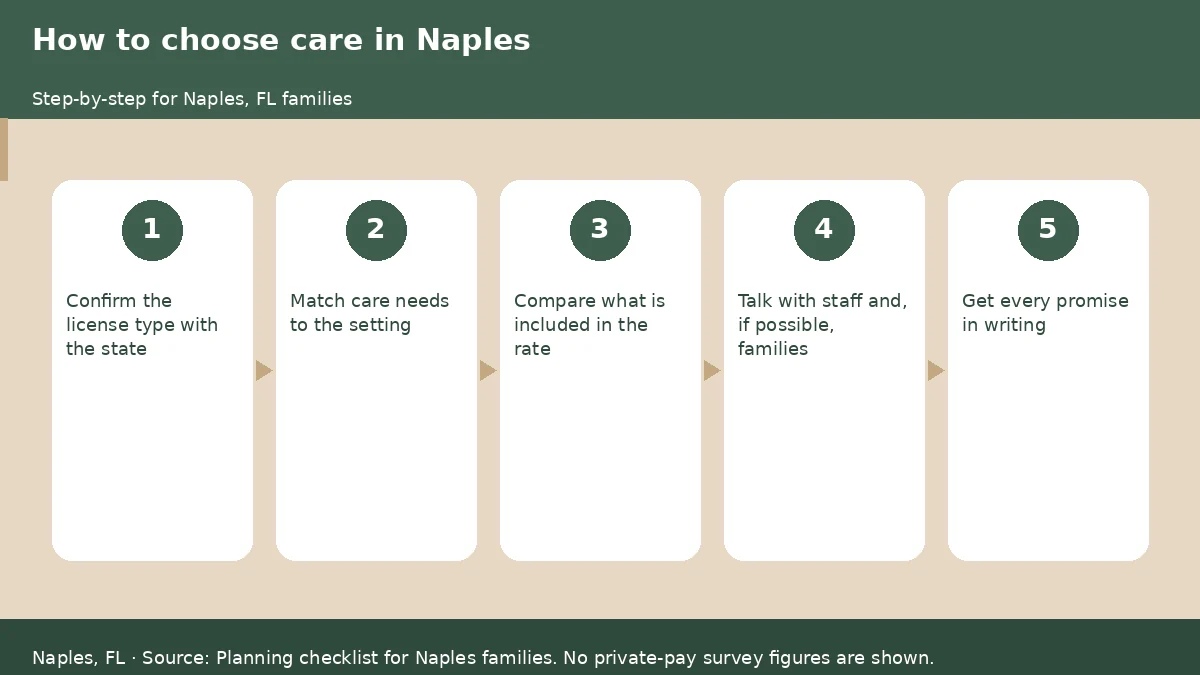
Collier County has a long list of assisted living options, from large resort-style communities along the coast to small residential homes on large lots in the quieter neighborhoods east of town. With so many choices, families can feel pulled in several directions at once. This guide offers a clear sequence for narrowing the field and choosing a facility that fits your parent's needs, budget, and personality.
Step 1: Write down what your parent needs
Before you call or tour anywhere, describe your parent's daily life as honestly as you can:
- Help needed with bathing, dressing, grooming, toileting, eating, and getting around
- Medications, how many, and whether they are being taken correctly
- Memory changes, confusion, or wandering
- Recent falls, hospital stays, or new diagnoses
- Personality, routines, faith, food preferences, and hobbies
Florida's Agency for Health Care Administration says assisted living can be a good fit when daily tasks are getting harder, after a fall or hospital stay, when memory issues affect safety, or when living alone has become too hard (AHCA, Assisted Living in Florida guide, PDF). Your written profile will help each facility tell you honestly whether it can meet those needs.
Step 2: Understand Florida's license types
Every assisted living facility in Florida must hold a Standard License from AHCA. Some also hold specialty licenses:
- Extended Congregate Care (ECC), which lets residents age in place with more help, including total assistance with personal care, limited nursing services, and supervision of residents with dementia
- Limited Nursing Services (LNS), which allows licensed nurses to provide certain nursing care, though not 24-hour skilled nursing
- Limited Mental Health (LMH), required for facilities serving residents who receive state mental health case management
The license tells you a great deal about what a facility can do as needs change. Our article on Florida assisted living licensing explains each in more depth.
Step 3: Use FloridaHealthFinder.gov
AHCA's FloridaHealthFinder.gov lets you search by location and compare facilities by services, bed size, payment types, languages spoken, and inspection history. Facility profiles show contact details, license type, Medicaid eligibility, and inspection reports, and AHCA says the tools are updated nightly. Use it to build a shortlist and to note questions before you visit.
When reading inspection reports, look at the date and seriousness of each finding, whether it was corrected, and whether similar problems repeat.
Step 4: Decide on size and setting
- Small residential homes can feel like a household, with a handful of residents, home-cooked meals, and the same caregivers each day. Many people with memory changes find this calm setting reassuring.
- Larger communities offer private apartments, more amenities, and a fuller activity calendar, which suits people who enjoy a busy social life.
AHCA notes that facilities can range from cozy homes to larger campuses. Think about where your parent has been happiest in the past. Someone who spent decades in a house with a yard and a porch may feel more at home in a residential setting, while someone who loved condo life, with neighbors close by and something always happening, may prefer a larger community. There is no wrong answer, only a better or worse fit for the person.
Step 5: Think about location
Naples is spread out, and seasonal traffic can turn a short drive into a long one.
- Choose a facility close to the family member who will visit most often.
- Consider the drive to your parent's doctors and hospital.
- Think about familiar churches, clubs, and friends nearby.
- Ask how the facility handles hurricane season; see our guide to hurricane questions for Naples assisted living.
Step 6: Set a realistic budget
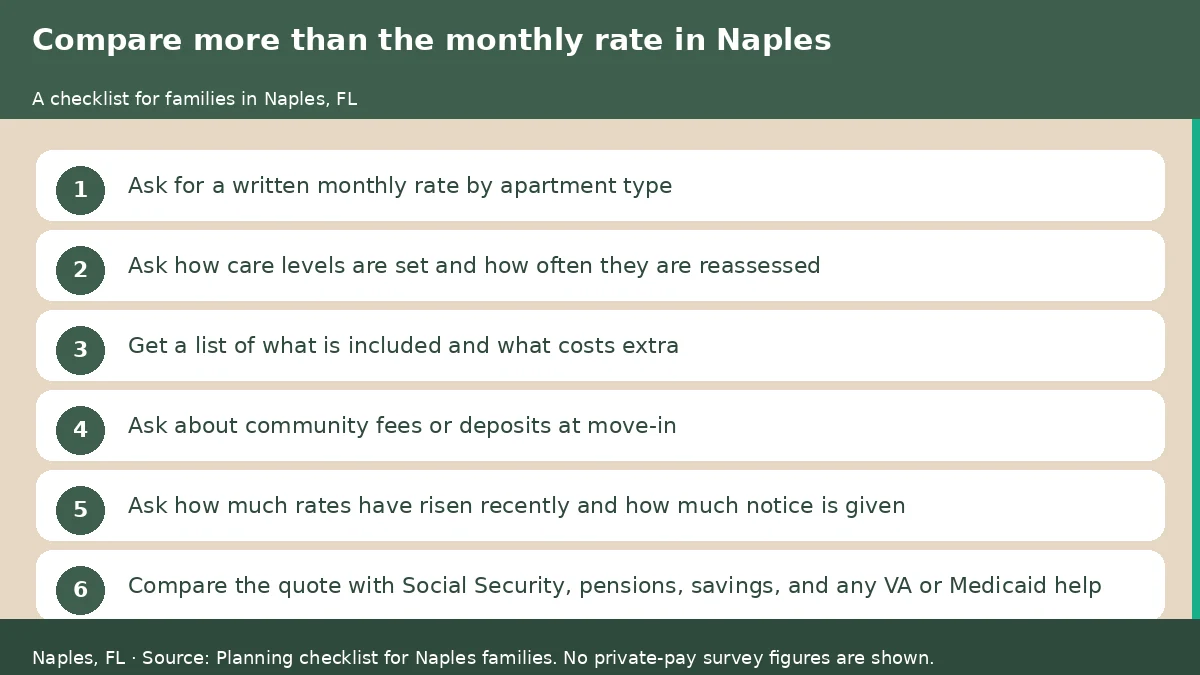
Get written quotes, and estimate how long your parent's income and savings will last. Ask whether facilities accept Florida's SMMC Long-Term Care plans or Optional State Supplementation, in case those are needed later. Our guide to assisted living costs in Naples explains what drives a quote.
Step 7: Visit at least twice
On a visit, watch more than you listen:
- How do caregivers speak to residents?
- Are residents engaged, groomed, and comfortable?
- What do the meals look and taste like?
- Is the building clean, and how does it smell?
- How does the place feel in the late afternoon, when many older adults are tired?
Plan a second visit at a different time of day. Our Naples assisted living tour checklist offers a structured way to take notes.
Step 8: Ask direct questions
- Which AHCA licenses do you hold?
- What care needs are beyond what you can provide?
- How many staff are on duty during the day and overnight? Is someone awake at night?
- Who helps with medications?
- How do you handle falls and medical emergencies?
- What is included in the rate, and what costs extra?
- How much notice do you give before raising rates?
- When would a resident need to move?
Step 9: Read the contract
AHCA's guide notes that every resident signs a contract or residency agreement covering housing and included services, optional services and fees, discharge and refund policies, bed-hold policies, and any special care plans. It suggests asking for a copy in advance and reviewing it with a friend or family member before signing. Florida facilities must give at least 30 days' written notice of a rate increase.
Step 10: Include your parent
Your parent's reaction to a place matters. Did they enjoy lunch? Talk with another resident? Seem at ease with the caregivers? People who feel part of the decision usually settle in more easily.
Know where to turn
The Florida Long-Term Care Ombudsman Program advocates for residents of assisted living facilities and nursing homes, at (888) 831-0404 (Florida Long-Term Care Ombudsman Program). For local services, the Area Agency on Aging for Southwest Florida's Elder Helpline is 866-413-5337 (Area Agency on Aging for SWFL, Elder Helpline).
Visit Bear Country Living
Bear Country Living is a residential home at 360 37th Avenue NE in Naples offering assisted living and memory care support. See our home, then call (239) 467-6054 to confirm current availability and plan a visit.
Frequently asked questions
How do I check an assisted living facility's license in Florida?
Use FloridaHealthFinder.gov. AHCA says every assisted living facility must be licensed, and the license status appears in the facility profile.
What license should a facility have for someone with dementia?
All facilities need a Standard License. An Extended Congregate Care license allows supervision of residents with dementia as needs grow, and any facility that advertises special Alzheimer's care must meet the standards in section 429.178, Florida Statutes.
How many facilities should we tour?
Two to four is typical, with at least two visits to your top choice.
Can an assisted living facility in Florida raise its rates?
Yes, with at least 30 days' written notice, according to AHCA.