Assisted Living or Memory Care? A Decision Guide for Naples Families
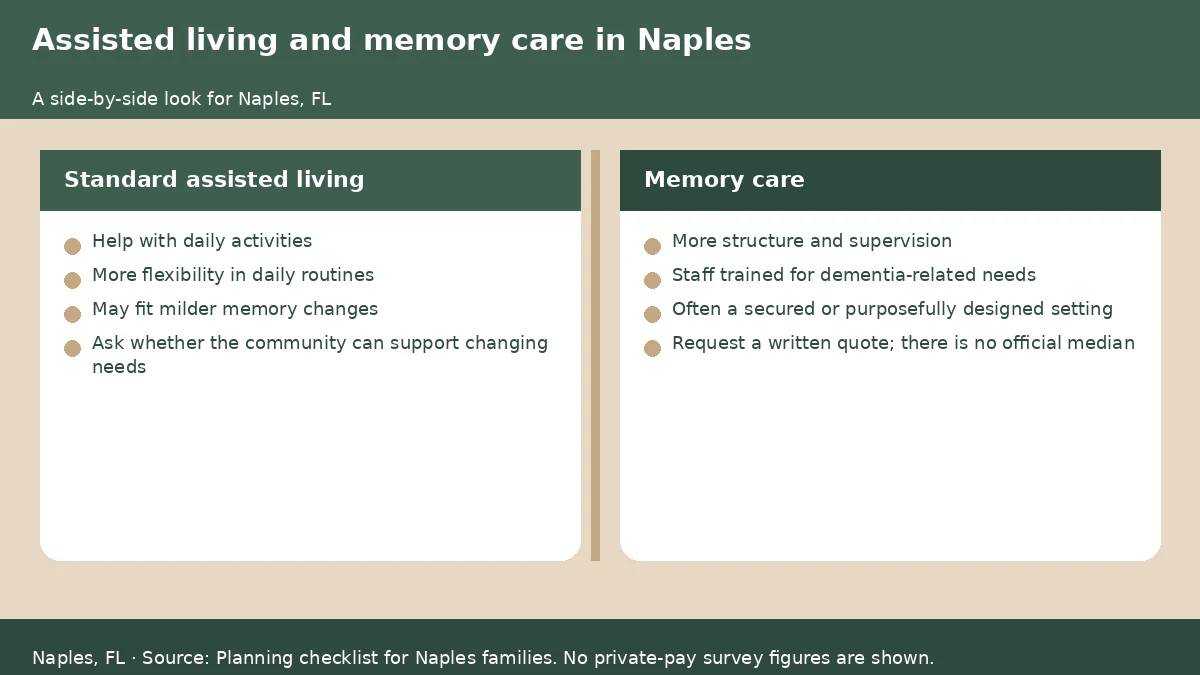
In Naples, memory care is a more structured setting than standard assisted living, often with additional staffing and security. Whether someone needs that setting depends on their safety and daily-care needs, not on a national average price. Ask communities for written quotes for both options when both are appropriate.
Medicare does not pay for room, board, or ongoing custodial care in assisted living if that is the only care someone needs (Medicare.gov: long-term care coverage).
Eligible wartime Veterans and surviving spouses can review VA pension with Aid and Attendance. As of December 1, 2025, the maximum annual pension rate with Aid and Attendance is $29,093 for a Veteran with no dependents and $34,488 for a Veteran with one dependent (current VA pension rates). A surviving spouse’s Aid and Attendance maximum is $18,697 a year with no dependent children (VA Survivors Pension rates). These are benefit limits, not the price of a Naples community. The net worth limit for these pensions is $163,699 from December 1, 2025, through November 30, 2026.
For local public-benefit counseling, start with the federal Eldercare Locator at 1-800-677-1116, which connects families to the Area Agency on Aging that serves Naples, Florida.
If your parent in Naples is showing signs of memory loss, you may be wondering whether assisted living can still meet their needs or whether memory care is the safer choice. The two settings overlap, but they are designed for different stages and needs. Choosing well protects your parent's safety and dignity, and helps your family avoid an unnecessary second move. This guide explains the differences and offers a practical way to decide.
What assisted living offers
Florida's Agency for Health Care Administration describes assisted living facilities as licensed communities that provide care and housing for adults who need daily support but do not require 24-hour nursing care (AHCA, Assisted Living in Florida guide, PDF). Under a standard license, facilities can help with bathing, dressing, and eating, provide or supervise medications, and offer meals, housing, and general supervision.
Assisted living works well for many people with mild memory changes who can follow a routine with reminders, ask for help, and enjoy activities with others.
What memory care offers
Memory care is for people whose dementia requires more structure and closer supervision. It usually provides:
- Staff awake and attentive at all hours
- Secured exits to prevent unsafe wandering
- Staff trained to communicate with and reassure people who are confused
- Daily routines and activities adapted to cognitive abilities
- A calmer, simpler environment
Memory care offers support and a safer environment. It does not cure dementia or halt its progression.
Florida's rules for dementia special care
Florida law sets specific standards for any assisted living facility that advertises special care for people with Alzheimer's disease or related disorders. Section 429.178 of the Florida Statutes requires an awake staff member on duty at all hours (or, in facilities with fewer than 17 residents, either awake staff or mechanisms to monitor residents' safety), activities designed for cognitively impaired residents, a safe physical environment, and staff who complete required dementia training (Florida Statutes, s. 429.178).
The AHCA guide also notes that facilities with an Extended Congregate Care license may supervise residents with dementia or cognitive impairments, helping residents age in place. Ask each facility which licenses it holds and how it meets these requirements.
Signs assisted living may still be enough
- Your parent forgets things but follows a routine with reminders
- They are not trying to leave or getting lost
- They can ask for help when they need it
- They generally sleep through the night
- They enjoy and can join group activities
Signs memory care may be needed
- Wandering or trying to leave, or getting lost in familiar places
- Being unsafe with doors, the stove, or medications even with reminders
- Needing step-by-step help with dressing, bathing, or eating
- Increased confusion or agitation in the late afternoon and evening
- Frequent night waking
- Not recognizing danger, such as traffic or heat
In Naples, heat is a real concern. A person with dementia who wanders outdoors in summer may not recognize signs of dehydration or heat stress, which makes supervision even more important.
Cost
Local prices vary; get written quotes. See our guide to memory care costs in Naples.
The role of setting
Some families find that a small residential home with a handful of residents and consistent caregivers suits a parent with moderate memory changes, because it is quiet and predictable. Others prefer a larger community with a dedicated memory care neighborhood and structured programs. The best choice depends on your parent's personality, needs, and how they respond to noise and activity. Visit both kinds of setting if you can, and pay attention to how your parent responds in each. Some people visibly relax in a small, quiet house; others light up in a busier place with more going on. Their reaction is valuable information, so make note of it.
Start with a doctor's evaluation
Before making a decision, ask your parent's physician for an evaluation. Some causes of memory problems, such as medication side effects, infections, thyroid problems, vitamin deficiencies, or depression, are treatable. Bring specific examples of what you have seen. If dementia is diagnosed, ask what level of supervision is likely to be needed over the next year.
Planning for change
Dementia changes over time. When you choose a setting, ask what happens as needs increase:
- Can my parent stay if they need more help?
- At what point would you recommend a different setting?
- How much notice would we have?
- How would costs change?
A setting that can adapt may spare your parent the stress of moving again. Moves are hard for anyone, and they can be especially unsettling for someone living with dementia, who may need weeks or months to feel at home in a new place. Choosing a setting with an eye to the next year or two, rather than only to today, is one of the kindest decisions a family can make.
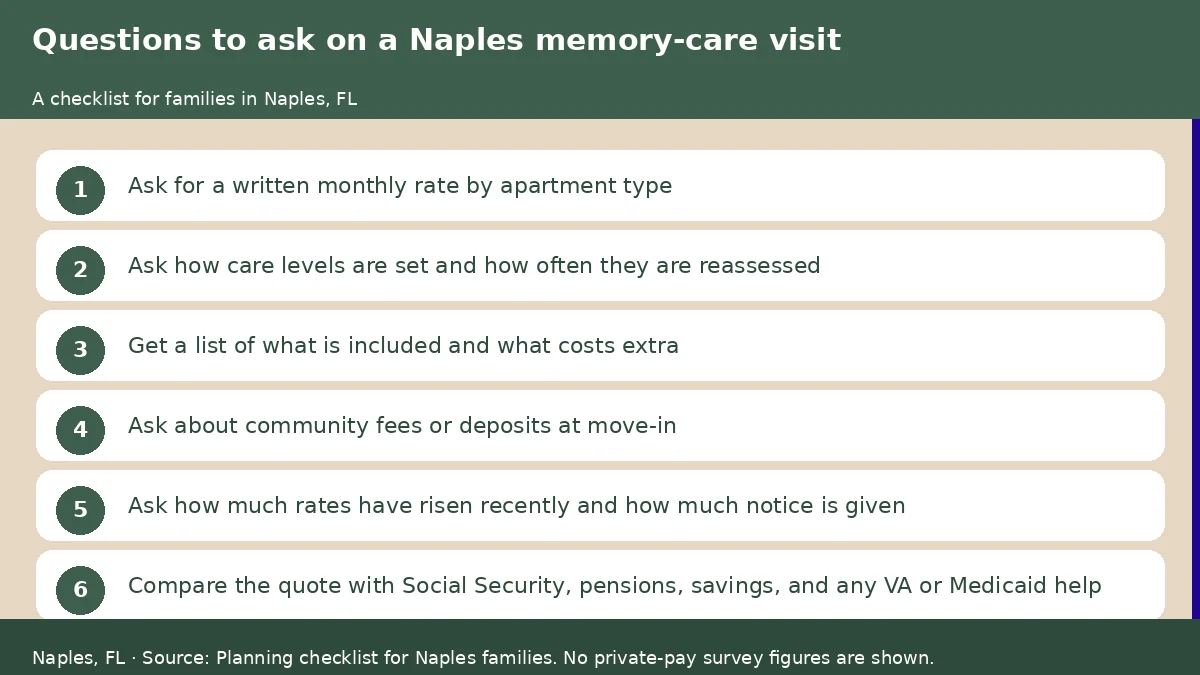
Questions to ask on a visit
- Can you care for someone with my parent's level of memory loss?
- How do you meet Florida's requirements for Alzheimer's special care?
- How many staff are awake at night?
- What dementia training have your caregivers completed?
- How do you respond to anxiety, agitation, or attempts to leave?
- How do you keep residents cool and hydrated in summer?
- How do you keep families informed?
Local support
The Area Agency on Aging for Southwest Florida's Elder Helpline can connect Collier County families to caregiver support and other services at 866-413-5337 (Area Agency on Aging for SWFL, Elder Helpline).
Talk with Bear Country Living
Bear Country Living is a residential home at 360 37th Avenue NE in Naples offering assisted living and memory care support. Call (239) 467-6054 to talk about your parent's needs and confirm current availability, or plan a visit.
Frequently asked questions
What is the difference between assisted living and memory care?
Memory care adds closer supervision, secured exits, dementia-trained staff, and routines adapted for people whose dementia makes standard assisted living unsafe or overwhelming.
Can a person with dementia live in assisted living in Florida?
Many people with mild memory changes do well in assisted living. Facilities that advertise special Alzheimer's care must meet additional standards under section 429.178, Florida Statutes.
Is memory care more expensive than assisted living?
Generally, yes.
How do I know when it is time for memory care?
Common signs include wandering, safety problems even with reminders, needing step-by-step help with daily tasks, evening agitation, and frequent night waking. A physician can help assess needs.